
IRD 92 E
CO2 GAS LEAK DETECTOR
CO2 / R744
The IRD 92 E is a portable infrared leak detector for CO2 / R744, designed for leak testing by sniffing at atmospheric pressure.In the same range:
For HFC, HFO and HC refrigerant gases and H2/N2 tracer gas (Nidron), the DXR 240 offers 3 sensitivity positions and a choice of 2 detection cells. For selective detection of H2/N2 tracer gas (Nidron), the DXH 240 offers 4 sensitivity positions and 2 detection modes, Detection and Track.
Accessories:
Verification at a specific CO2 leak rate can be carried out with the FCH 99M-PVA-R150 adjustable calibrated leak with built-in reservoir.
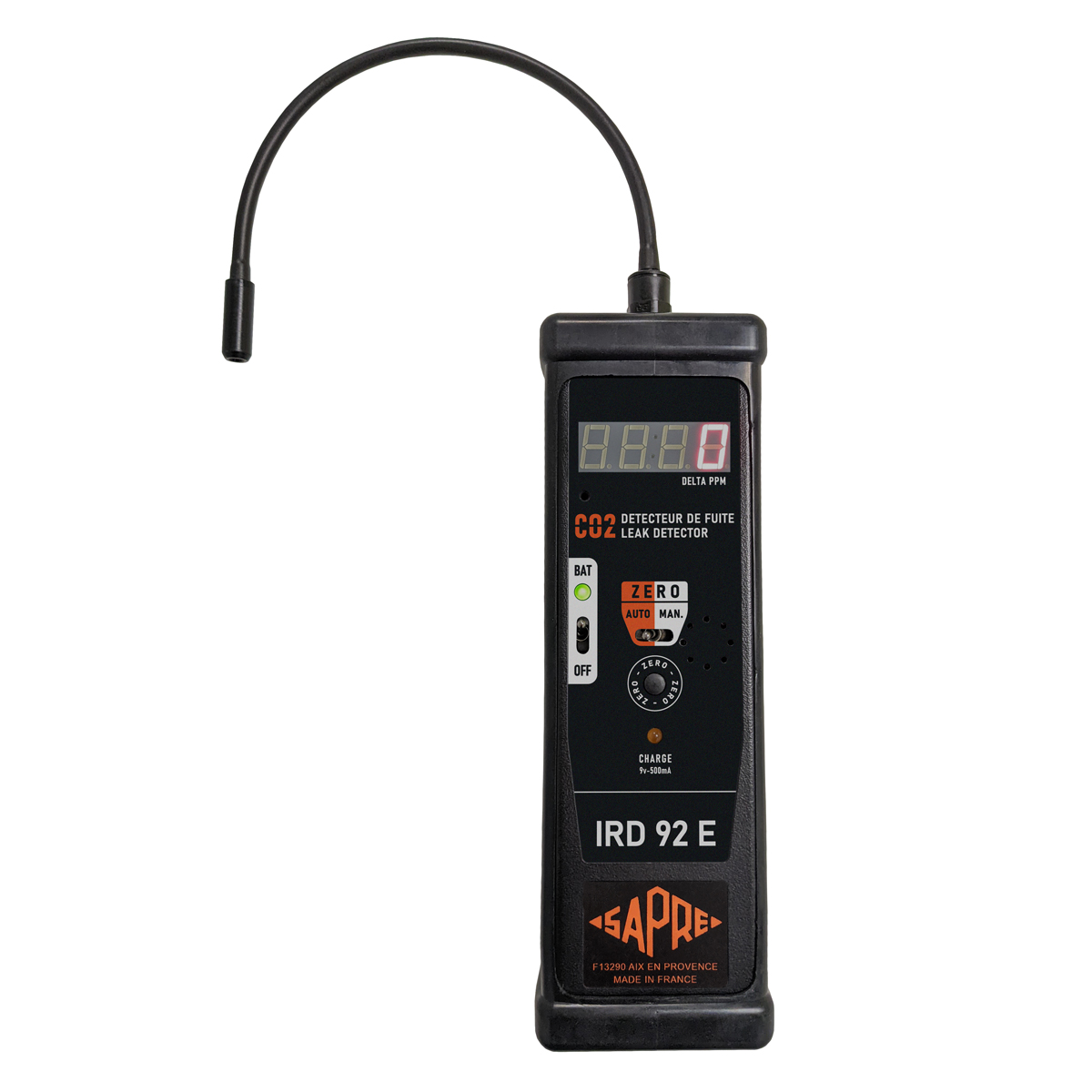
- Selective sensor with high detection performance for CO2/R744 gas.
- 4-digit digital display giving an estimate of the change in CO2 concentration in the area.
- Flexible shape-memory (gooseneck) probe.
2 detection modes:
- Manual ZERO mode: readout of the CO2 concentration change from 10 to 9,999 “delta ppm”.
- Automatic ZERO mode: detection of CO2 leaks with a minimum sensitivity of approx. 5 g/yr.
Find this product here:

Functions | Manual ZERO mode: readout of the CO2 concentration change. Automatic ZERO mode: CO2 leak detection. |
| Display | 4-digit digital display with progressive audible signal. |
| Cell | NDIR infrared cell, with an infrared spectrum centred on CO2. |
| Detected gases | CO2 / R744. |
| Sensitivity | Manual ZERO mode: 10 to 9,999 “delta ppm”. Automatic ZERO mode: 5 g/yr. |
| Battery life | 6–8 h |
| Power supply | Built-in rechargeable batteries. Charging time around 12 hours. |
| Delivered with | Supplied complete in a carrying case with mains charger and user manual. Protective rubber boot included. |
| Option | None |