
SGD 240
LEAK DETECTOR FOR UNDERGROUND NETWORKS
H2/N2 TRACER GAS (FORMING GAS) & NIDRON
The SGD 240 is a portable gas leak detector for the detection of H2/N2 tracer gas (forming gas) or Nidron. Designed for leak testing of underground or buried networks by sniffing at atmospheric pressure.In the same range:
For leak detection with H2/N2 tracer gas (Nidron) outside underground networks, the DXH 240 offers 4 sensitivity positions and 2 detection modes.
Accessories:
For quick SGD 240 sensitivity verification, use the FT 92-T test leak (equivalent to 5 g/yr, H2/N2 version).
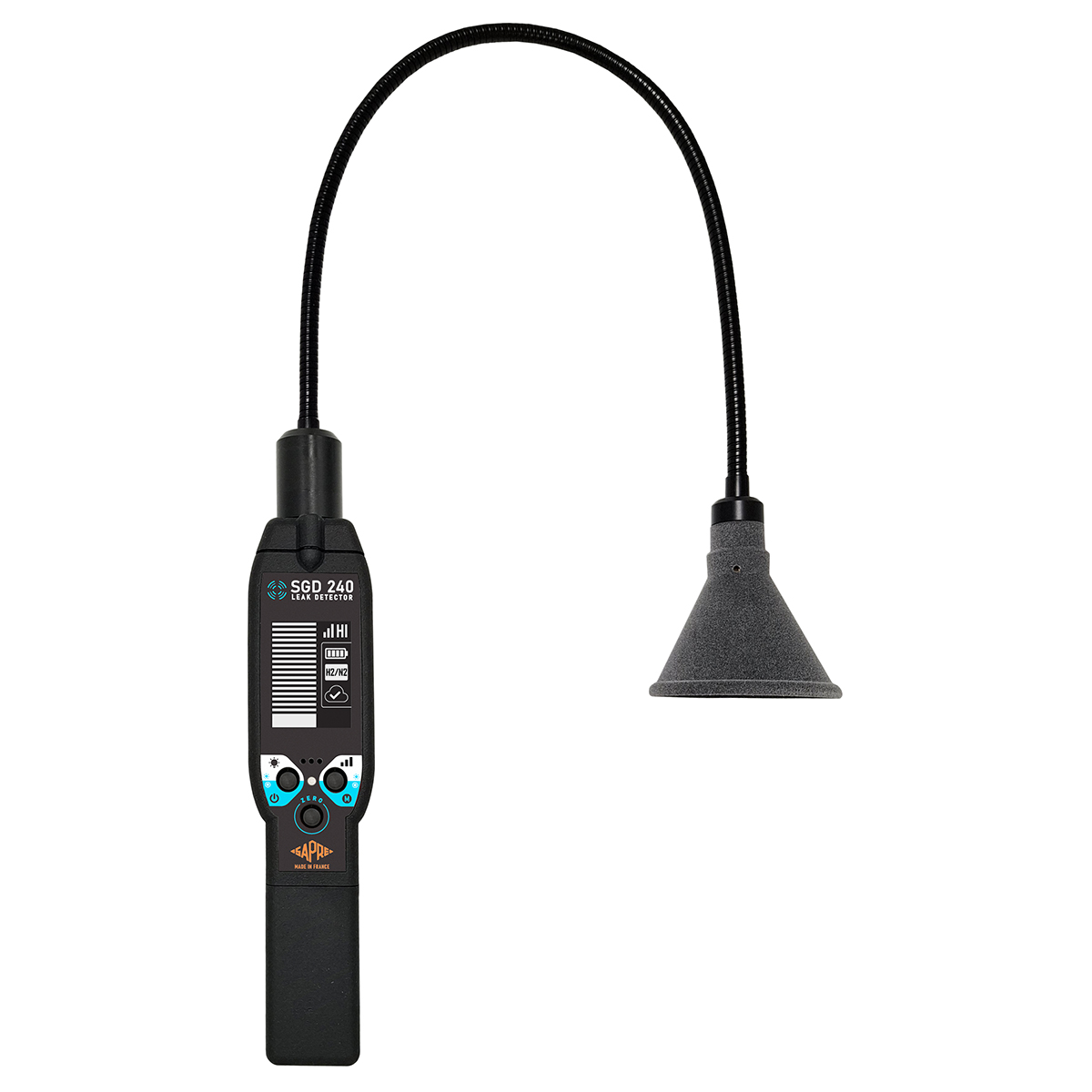
- Leak detector for leak testing of underground or buried networks using H2/N2 tracer gas or Nidron.
- Sniffer cone designed for ground-level detection.
- Graphic display with bar graph for efficient leak pinpointing.
2 detection modes:
- Detection mode with auto-zero.
- Track mode for leak location.
4 sensitivity positions.
Detection cell:
- Selective detection cell for the H2/N2 tracer gas mixture.

| Functions | 4 sensitivity positions. 2 detection modes: Detection Mode and Track Mode. Contamination-saturation indication. LED light at the top of the housing to illuminate dark detection areas. Replaceable and interchangeable detection cell. | |
| Display | Graphic display with bar graph and progressive audible signal. | |
| Cell | Electrochemical. | |
| Detected gases | Specific tracer gas cell: H2/N2, Nidron. | |
| Sensitivity | 1×10⁻⁵ cc/s for H2/N2 tracer mixture [approx. 1 g/yr refrigerant equivalent] | |
| Battery life | 8 h | |
| Power supply | Built-in rechargeable batteries. Charging time around 12 hours. USB-C charging port. | |
| Delivered with |
| |
| Option | n/a |